Water Cycle Worksheets for Grades 6-8 (Free Sample + Full Unit)
Download a free water cycle worksheet for Grades 6-8 below: one student page with an answer key, ready to print. If you want the whole topic covered, the full unit is two illustrated lessons on how the Sun lifts water and how gravity brings it down, with guided notes, model tasks, reading checks, data tasks using real USGS numbers, vocabulary cards and a quiz, for USD 4.50 on TPT.
Free sample worksheet
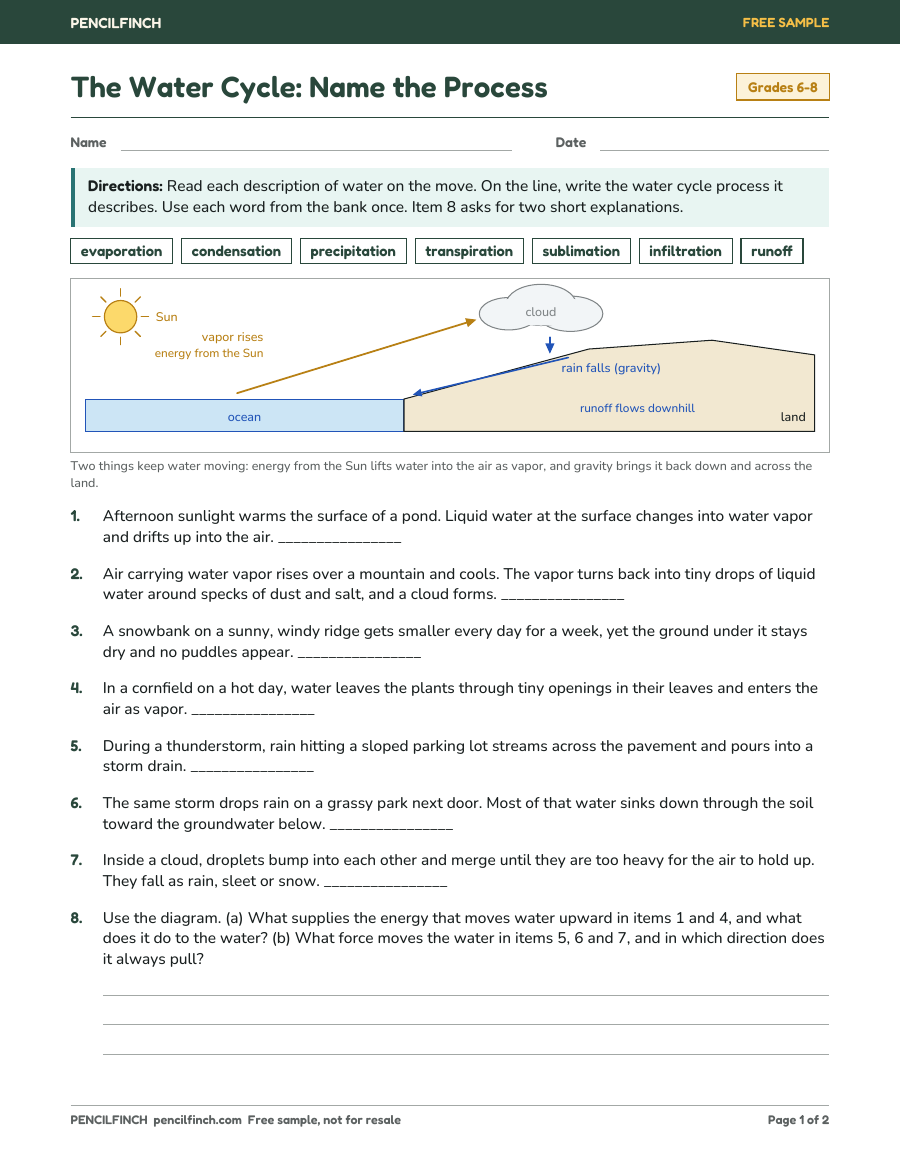 Download the free sample (PDF, 8 items with answer key)
Free to download, no email needed. These problems are not in the paid unit.
What is in the full unit
| Full unit | Water Cycle Science Lessons | Evaporation, Condensation & Runoff | Grades 6-8 |
|---|---|
| Pages | 29 pages in one PDF |
| Answer key | Included with Rubric |
| Standards | NGSS MS-ESS2-4 |
| Grades | 6-8 |
| Price on TPT | USD 4.50 |
Get the full unit on TPT (USD 4.50)
- Lesson 1, The Sun lifts water: evaporation, transpiration and sublimation, why rising air cools, condensation on dust and salt, flat cloud bases, crystallization and why precipitation falls. Students name the change of state at each step of a model.
- Lesson 2, Gravity brings water down: runoff, watersheds, streamflow, infiltration, groundwater and the water table, snowmelt, glaciers, many paths and residence times. Students trace fast and slow paths in a model.
- Two Prove-it data tasks with CER: one uses real USGS estimates of Earth's water to find how long water stays in the air; the other uses real USGS streamflow data from Peachtree Creek in Atlanta to explain where a creek's water comes from between storms.
- Explanation pages with three scene illustrations drawn in code (no AI image generator), guided notes, reading checks, two pages of picture vocabulary cards and a 10-question quiz.
- Answer key for every question with scoring rules, completed notes and models, and model CER answers; a two-lesson plan with two optional demos, misconceptions and printing notes for the teacher.
Pages from the unit
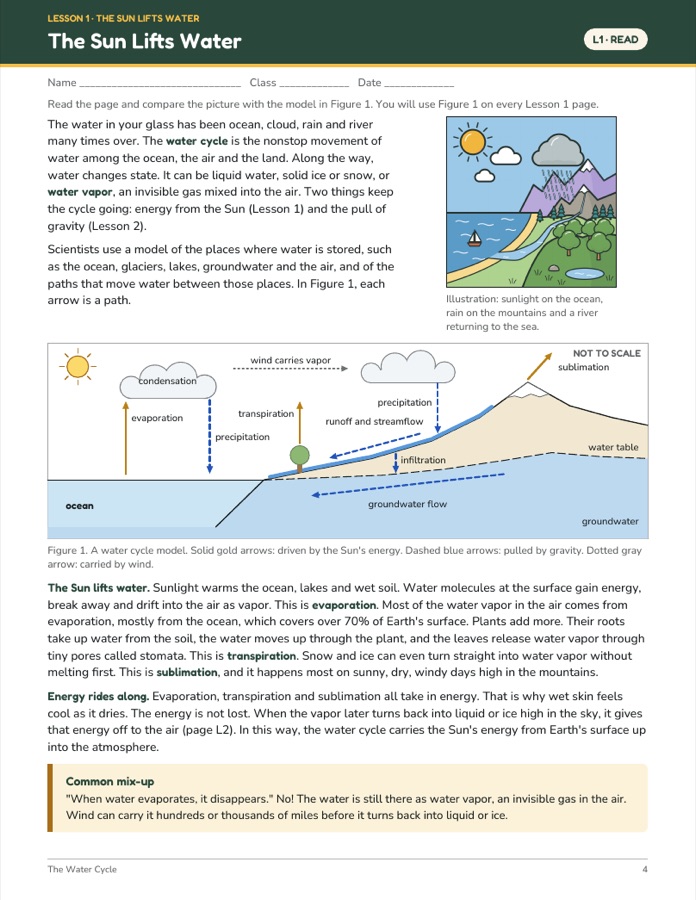
Page 4 of 29 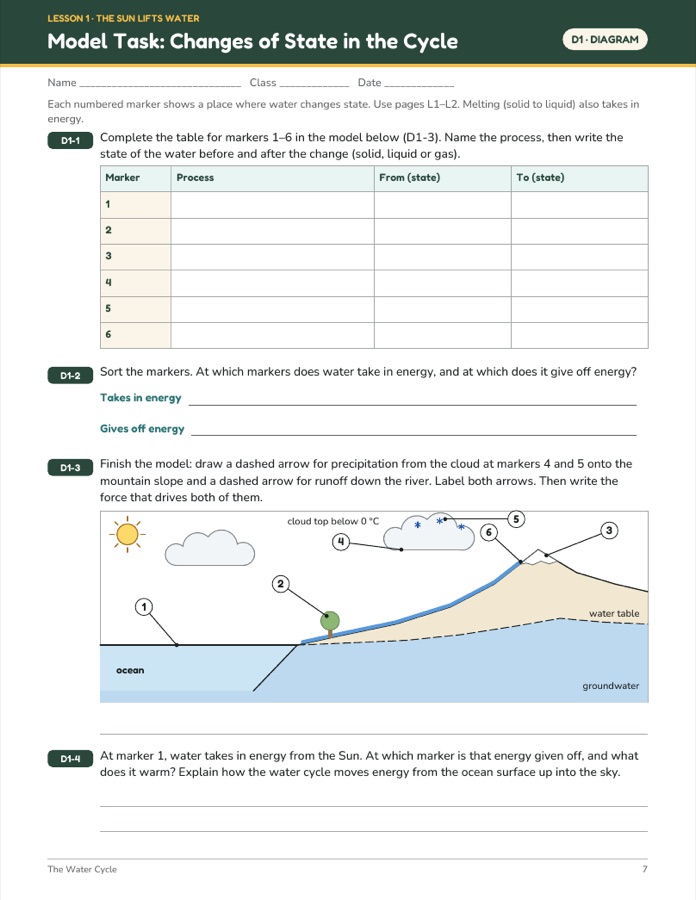
Page 7 of 29 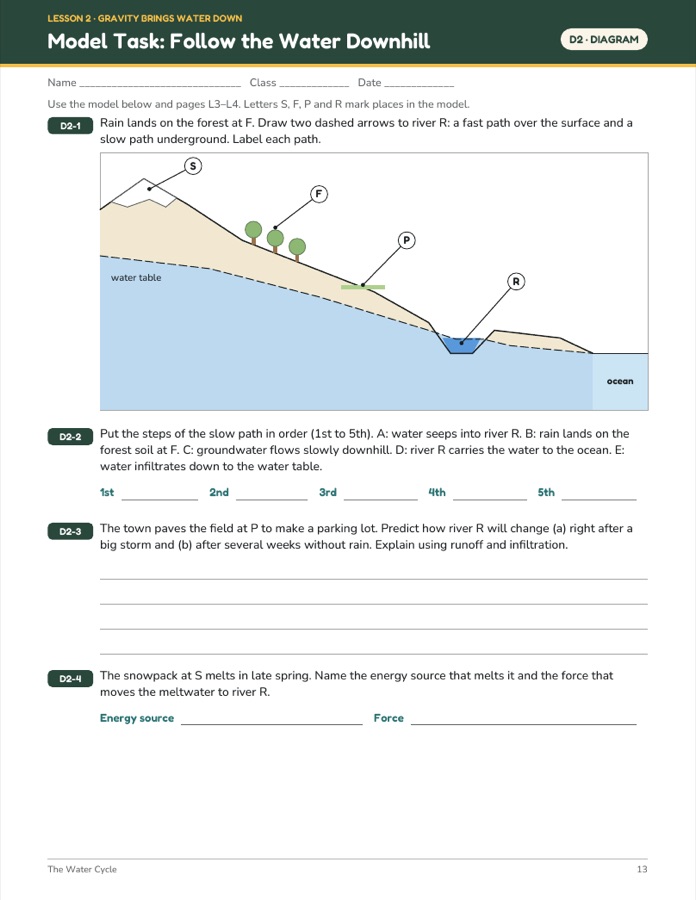
Page 13 of 29
Student pages are designed to print in black and white; all labels, numbers, models and graphs are printed text and vector drawings.
How teachers use it
The water cycle is the nonstop movement of water among the ocean, the air and the land, kept going by energy from the Sun and the pull of gravity. Each lesson is planned for about 50 minutes. Students read the explanation pages first, then work the guided notes, the model task and the reading check. The Prove-it page closes the lesson with a short data task and a claim-evidence-reasoning write-up, so you can see who can use the model and who is still memorizing arrow names.
The free sample on this page works as a warm-up or an exit ticket on the day you introduce the cycle. Its items are new and are not in the paid unit, so students who later see the full lessons do not repeat them.
If you teach the water cycle as a model of energy and gravity rather than a list of words, the unit follows that order: Lesson 1 is the energy half, Lesson 2 is the gravity half, and the two Prove-it tasks ask students to argue from real USGS data. The listed prerequisites are reading a simple table, bar chart and line graph, and adding and dividing whole numbers.
The unit supports and connects to NGSS MS-ESS2-4 (a model of water cycling through Earth's systems driven by energy from the Sun and the force of gravity). That is not a claim of full alignment, and the standards table above shows only what the listing states.
Before and after this topic
Weathering, erosion and deposition is a natural next topic, since runoff and streamflow show up again as agents of change.
- After this topicWeathering, Erosion, Deposition Worksheets Grades 6-8 (Free Sample)
- All topics in this lineMiddle School Earth and Space Science Worksheets (Grades 6-8)
Common questions
Is the free worksheet the same as a page from the paid unit?
No. The sample is written separately for this site, and its problems are not in the unit. It uses the same page style, so you can see what the student pages look like before you buy.
Do students need color printing?
No. Student pages are designed to work in black and white. The illustrations and models are line drawings and printed text, so a plain copier is fine.
Does the unit use real data?
Yes. Both Prove-it tasks use real USGS data: estimates of how much water rises into the air and falls as precipitation each year, and daily rain and streamflow for Peachtree Creek in Atlanta, Georgia. Sources are listed on the teacher pages inside the PDF.