Metric Conversions Worksheets for Grades 6-8 (Free Sample + Full Unit)
Download a free metric conversions worksheet for Grades 6-8 below: one student page with an answer key, ready to print. The full unit it comes from is Lab Safety and Metric Measurement, two illustrated lessons for the start of the science year: Lesson 1 covers lab safety, and Lesson 2 teaches SI units, the kilo-, centi- and milli- prefixes, a prefix ladder for conversions and how to read a ruler, a graduated cylinder and a thermometer, for USD 4.50 on TPT. A separate three-level metric conversions skill ladder is coming.
Free sample worksheet
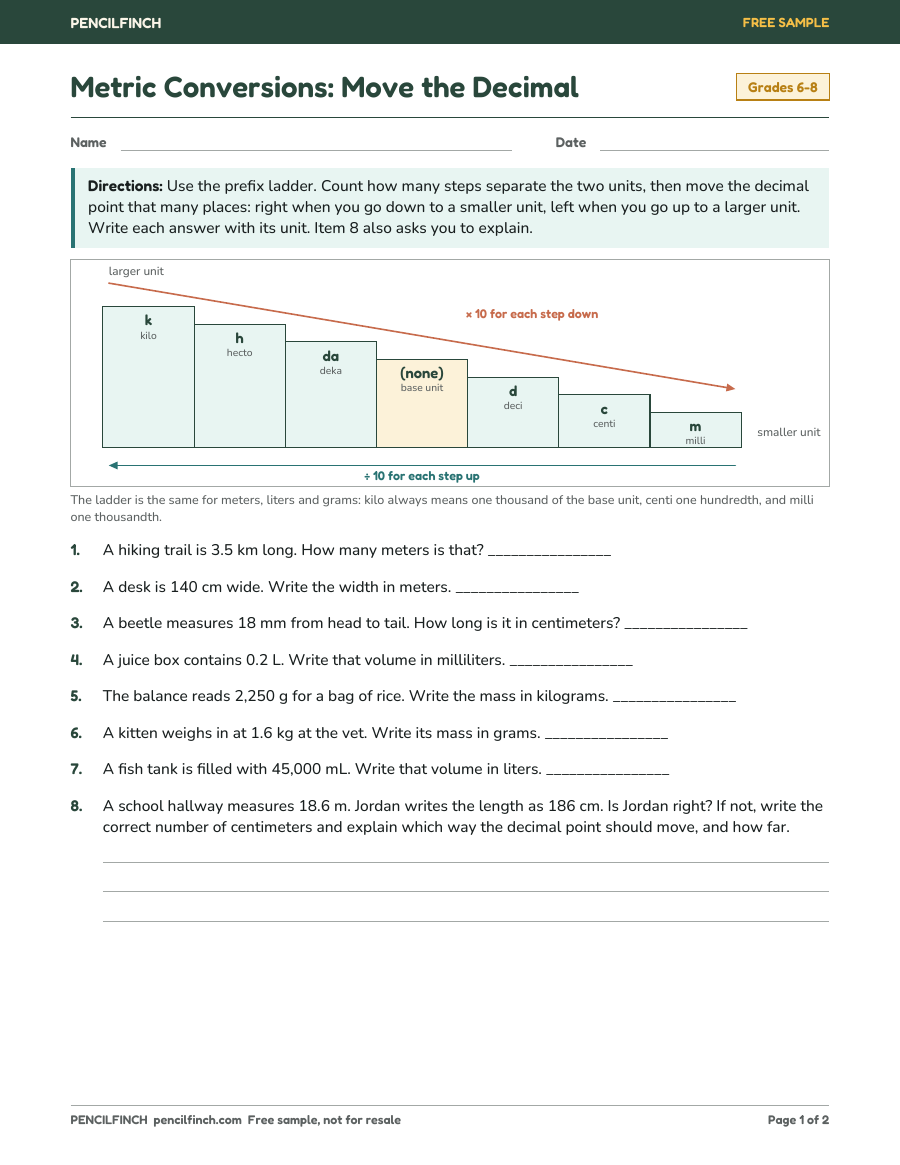 Download the free sample (PDF, 8 items with answer key)
Free to download, no email needed. These problems are not in the paid unit.
What is in the full unit
| Full unit | Lab Safety & Metric Measurement Science Lessons | Lab Equipment | Grades 6-8 |
|---|---|
| Pages | 28 pages in one PDF |
| Answer key | Included with Rubric |
| Standards | CCSS RST.6-8.3 |
| Grades | 6-8 |
| Price on TPT | USD 4.50 |
Get the full unit on TPT (USD 4.50)
- Lesson 2, metric measurement with lab tools: SI units, the kilo-, centi- and milli- prefixes, a prefix ladder for conversions, writing units correctly, reading a ruler, a graduated cylinder (lowest point of the meniscus at eye level) and a thermometer, the value of a small mark, displacement, and mass vs. weight.
- An instrument-reading task and a Prove-it task where students follow a measuring procedure and use simulated class data to decide which result to trust.
- Lesson 1, lab safety: RAMP (recognize, assess, minimize, prepare), hazard vs. risk, personal protective equipment, emergency equipment, the nine GHS hazard pictograms, the signal words Danger and Warning, and safe procedures. Students spot seven hazards in a lab scene, read two simulated chemical labels and write a CER about heating a flammable liquid.
- Explanation pages with two scene illustrations drawn in code (no AI image generator), guided notes, reading checks, two pages of picture vocabulary cards and a 10-question quiz.
- Answer key for every question with scoring rules, completed notes, circled hazards, a meniscus drawing and model CER answers; a two-lesson plan with an optional safety walk and water-only measuring stations, misconceptions and printing notes.
Pages from the unit
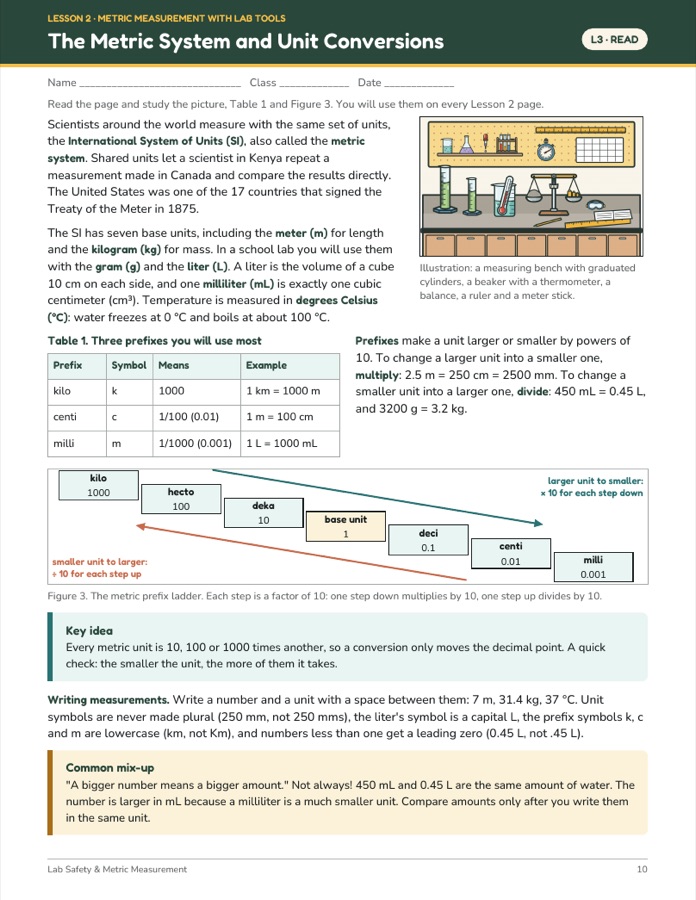
Page 10 of 28 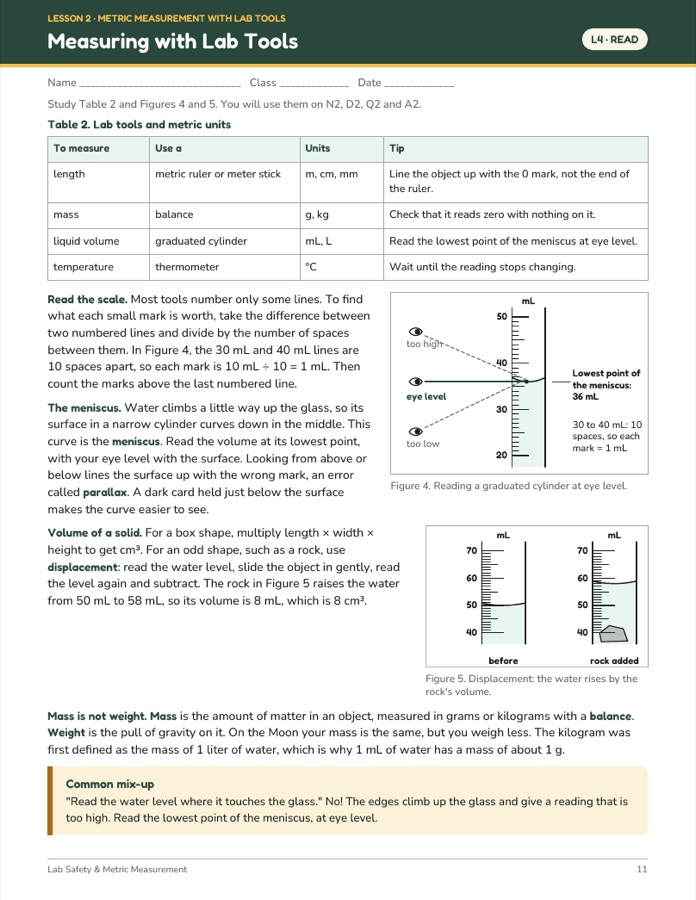
Page 11 of 28 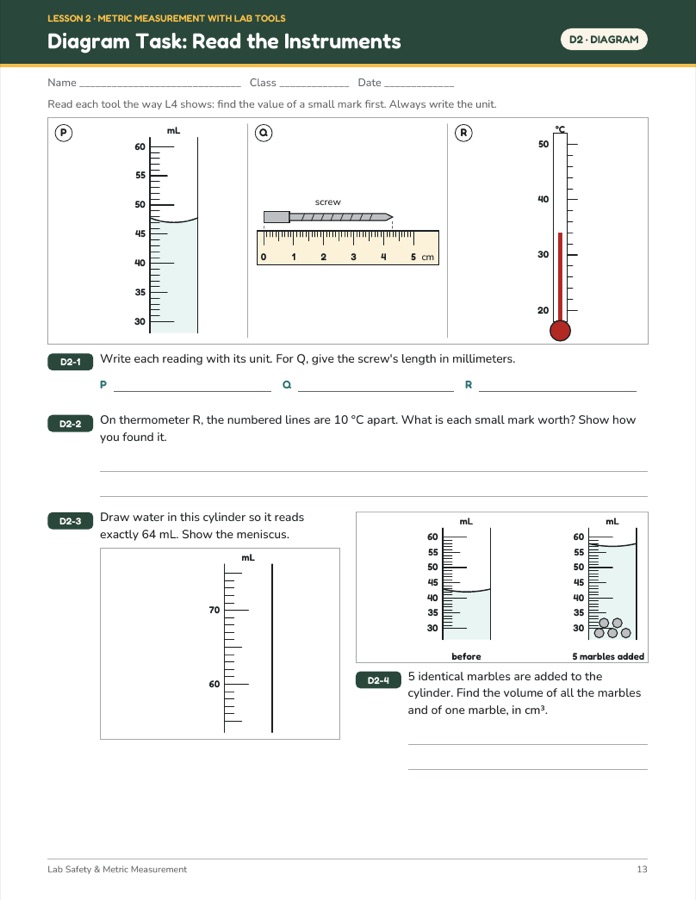
Page 13 of 28
Student pages are designed to print in black and white; all labels, numbers, scales and pictograms are printed text and vector drawings.
How teachers use it
A metric prefix makes a unit larger or smaller by a power of 10: kilo- means 1000, centi- means one hundredth and milli- means one thousandth. The metric lesson is built around one idea: every metric unit on the prefix ladder is 10, 100 or 1000 times its neighbor, so a conversion only moves the decimal point. Students read the explanation pages, fill the guided notes, then practice on the instrument-reading task before the Prove-it page asks them to follow a procedure and judge simulated class data.
The free sample on this page is a metric conversions practice page with an answer key. Its items are new and are not in the paid unit, so it can serve as a diagnostic before the lesson or a quick check after it.
The plan runs Lesson 1 (lab safety) first and Lesson 2 (measurement) right after, each in about 50 minutes, which fits the first week of the year. No chemicals are needed; the optional stations use water only. The listed prerequisites are multiplying and dividing by 10, 100 and 1000.
The unit supports CCSS ELA-Literacy RST.6-8.3 (follow precisely a multistep procedure when carrying out experiments, taking measurements, or performing technical tasks) and connects to RST.6-8.4. No NGSS performance expectation is claimed, and the listing is clear that this is not a claim of full alignment.
Before and after this topic
This is a start-of-year unit, so it usually comes before the first content unit in physical science; a three-level metric conversions skill ladder for differentiated practice is coming and will be linked here when it is live.
- All topics in this lineMiddle School Physical Science Worksheets (Grades 6-8)
Common questions
Is this only a conversions worksheet, or a full lab safety unit too?
Both. The free sample is a conversions page. The paid unit has two lessons: lab safety and metric measurement with lab tools. The conversions content lives in Lesson 2.
Do students need any lab equipment?
Not for the pages: students read a ruler, a graduated cylinder and a thermometer from printed drawings. The optional measuring stations in the teacher plan use ordinary measuring tools and water only, and no chemicals are needed.
Are the chemical labels and class data real?
The two chemical labels and the class data are simulated and are labeled that way in the pages. The label statements use real GHS wording.